Walkthrough of a Human Agent’s Workflow – with an eye toward Digital Agents

I am having too much fun fleeing my WordPress instance for Eleventy. I am impressed with how quickly I have already managed to put together some classic Mac OS-inspired pages. I’m working on getting the blog mechanism to work with the templates next, but that will take a while. So in the meantime, I will Sally Forth with my existing blogging rig and continue the themes I touched on in my previous post.

Setting the Scenario: Renewing Social Benefits for an Elderly Relative

My last post was freshly inspired by the frustration I am having renewing Medicaid coverage for an elderly relative. For those who have not had the pleasure of renewing Medicaid, for themselves or for someone else, there is an inherent amount of friction baked into the process that can often lead to unnecessary denials for those who qualify. For those with the time and resources necessary to navigate the system, it’s an exhausting endeavor. For those without the time or resources necesssary to navigate the system, it is often completely prohibitive.

I want to introduce you to the agents and workflows typically involved in this kind of Medicaid scenario.

Defining the Agents and Agencies in our Scenario
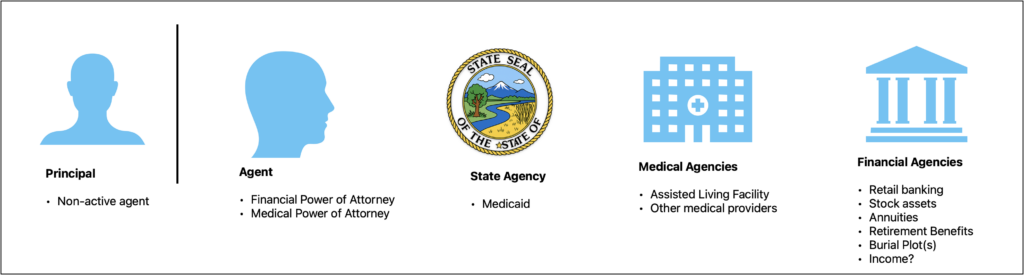
Visual diagram categorizing the agents and agencies involved in the Medicaid Renewal Scenario: Principal, Agent, State, Medical and Financial Agencies.

Principal – I’m borrowing this legal term to define the person on whose behalf the agent is working for. In the context of workflows we’ll discuss, they are typically a relative who is unable to manage their own affairs.

Agent – The agent is the person authorized to act on behalf of the principal. Authorization is provided in the form of a letter granting Power of Attorney (POA). There are typically two types of POA: Medical and Financial. Medical POAs (mPOAs) are given the authorization to make medical decisions on behalf of the principal. Financial POAs(fPOAs) are given the authorization to make financial decisions on behalf of the principal. I’m focusing the scope primarily based on my experience as a Financial POA (fPOA).

State Agency – States are typically given the jurisdiction of running their State’s Medicaid program. When initially applying for Medicaid, another agency such as an Assisted Living Facility, may reach out the State agency to put the State Agency in touch with the fPOA. (Experiences differ from State to State – your mileage may vary).

An AI-generated image of a generic state seal. It shows a seal with an image in the center showing a river, with a forest on one side and grain on the other. The ring around the image reads 'State Seal of the State of.'
I asked ChatGPT to generate a generic state seal. I normally don’t enjoy AI slop, but, in this case, I love it.

Medical Agencies – These are the medical agencies relating to the Principal. I have a main agency I work with, the Assisted Living Facility, but I also have to work with other medical providers as well. Your experience coordinating medical agencies may vary as well.

Financial Agencies – The financial agencies relating to the Principal. These are your typical financial retail products and services: banks, annuities, but you will also have to research and establish direct relationships with retirement benefits or other stocks and dividends. You also have to take into consideration other assets such as pre-paid burial plots.

Now that we know the agents, how do they interact? How do they even meet?

Simplified Agent Workflow
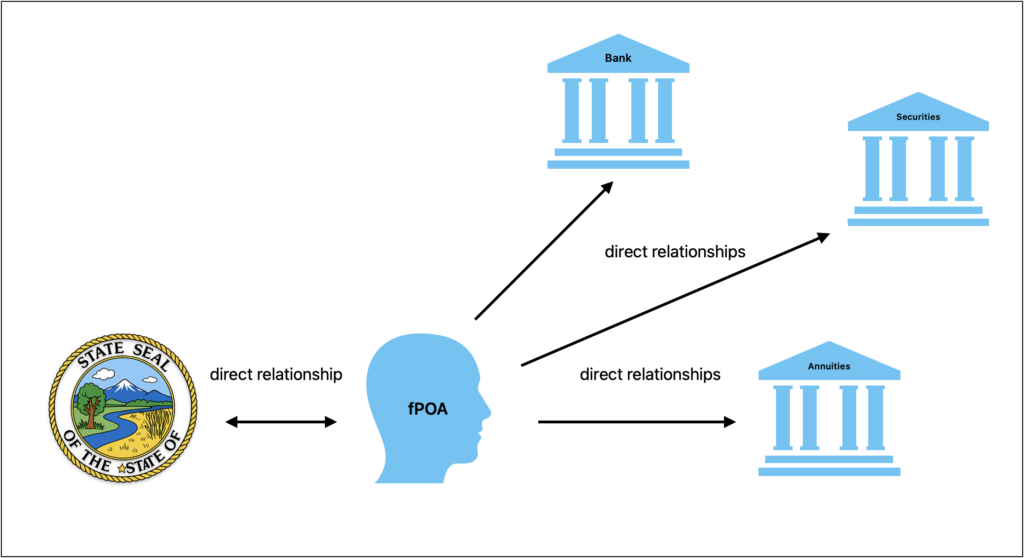
A diagram outlining the relationships between agents and agencies. It shows a two-way arrow between the State and the fPOA. The fPOA has one-way arrows pointing to three financial agencies (bank, securities, and annuities).

When the Principal’s Medicaid application is up for renewal, the fPOA is typically contacted by the State Medicaid agency. The State agency provides the fPOA a checklist of updated financial documents necessary for the Medicaid renewal. This checklist is usually a list of specific financial documents, such as updated statements, from various agencies.

As such, the fPOA must often reach out directly to each of the Principal’s financial institutions for updated documents. Each of these agencies has differing processes for authorizing and working with fPOAs, but rarely is the workflow online. And when it is online, it is often problematic for agents – I will explore this topic later. I will put a pin in it for now.

The fPOA and the State agency may be in direct touch, often via secure email. In that relationship, there is usually a responsive two-way interaction. The fPOA’s relationships to the various financial agencies, however, are often more “analog” and one-directional.

Most financial agencies, for example, require you to authorize – by phone – for each individual document request. Sometimes they ask you to resubmit Power of Attorney documents with each outreach. Often these requests are only fulilled by mail or even fax.

I want to walk through a workflow for obtaining one item on the State’s checklist, a financial letter from an annuity agency. As I describe these workflows, imagine how a generative AI agent would handle the same task. Bear in mind, this is only one item on the checklist provided by the State agency – for now we are not going to consider how a generative AI agent would manage the entire checklist.

A Simplified Workflow – Requesting a Current Financial Letter
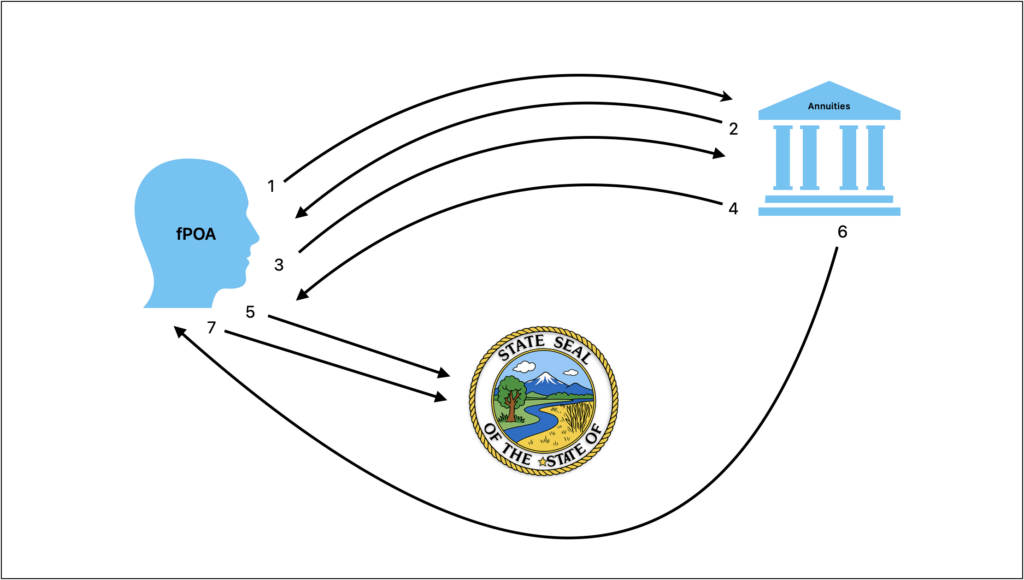
A diagram showing enumerated arrows between agent and agencies. Arrows 1-4 alternate between the fPOA and the financial agency. Arrow 5 is from the fPOA to the State agency. 6 is from the financial agency to the fPOA. 7 is an arrow from the fPOA to the State agency.

I’ve outlined a typical set of steps involved for an fPOA to contact a financial agency for a checklist item. In this case, we are requesting an updated financial letter from a retirement annuity holdings agency. What is described below is an optimal scenario, where nothing goes wrong. Ideally, most of this would happen over a phone single call but, depending on the agency, these steps might stretch out over days.

  1. Agent calls financial agency and declares POA status tand follows authorization process
  2. Financial agency confirms fPOA authorization
  3. Agent requests updated financial letter
  4. Financial agency confirms financial letter is being sent in the mail
  5. Agent notifies State agency that checklist item will arrive within 3-5 business days
  6. Financial letter arrives in the mail
  7. Agent scans and sends financial letter to State agency

This is just one workflow for one item on the checklist provided by the State agency. For this one workflow alone, you can see a number of barriers for a potential generative AI agent:

  • How does the generative AI agent work out the steps involved for each item on the checklist (phone, online)?
  • Assuming the agent is able to navigate a phone conversation, what mechanisms exist that allow the financial agency to authorize the generative AI agent?
  • Can generative AI agents check the mail? Or at least, can generative AI agents follow up with a human after several days?
  • Assuming the generative AI agent can handle the entire checklist from the State agency, can it keep track of the details for each task, how they relate to each other, and communicate only the pertient information to each of the parties in a secure manner?

My goal is not to denegrate the concept of digital agents. I do not think generative AI models are the best foundation for building digital agents. I believe generative AI models will play a part in enabling digital agents, namely as a natural language interfaces and specialized models, but the bulk of the foundational work for trustworthy digital agents will be in building robust, deterministic systems and web infrastructure. I also contend that this infrastructure can enable many of features we want from digital agents at a fraction of the cost of building with a generative AI-model first approach.

What I am proposing is not a new idea so much as a return to the original vision for digital agents. Sir Tim Berners-Lee proposed in 2001 public Semantic Web infrastructure as being the technology that would enable digital agents to work autonomously. The reason I suggest we revisit this original vision of the Semantic Web is that, nearly 25 years on, with AI hallucinations and misinformation rampant, this original vision is more prescient than ever. Lastly, I propose that, as we build out Semantic Web infrastructure for digital agents, it can make the web more easily navigable for humans in the process.
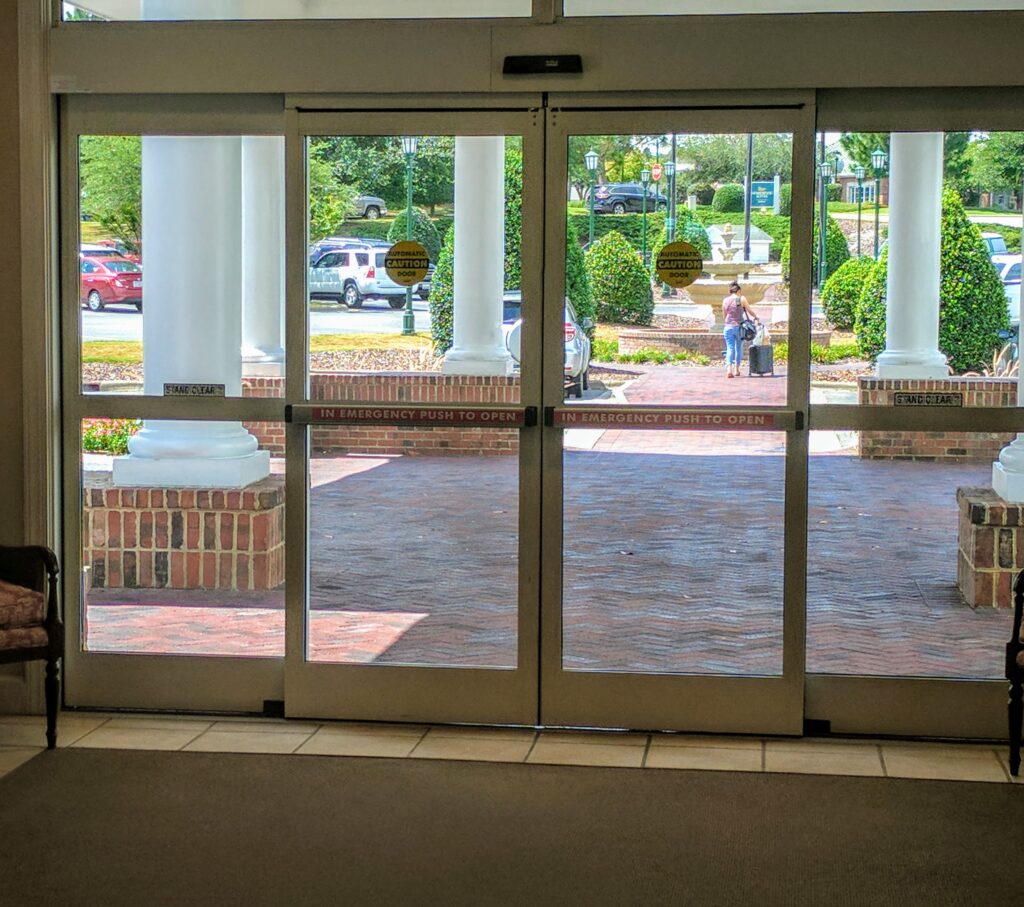
Automatic Door with Crash Bars. Scott Brody. Wikmedia Commons. CC BY-SA 4.0

The analogy I want to use for this Semantic web infrastructure are the visible effects of the American with Disabilities Act of 1990 on the design of public spaces in America. The design sensibilities that enabled greater accessibility for the disabled in public spaces (such as ramps and automatic doors) proved to have beneficial impacts for the greater society at large. I believe that Semantic Web infrastructure that we build to enable Trustworthy AI can reap dividends for the wider population beyond its initial stated scope. In short, I believe building Semantic Web infrastructure can be other example of universal design, with broad public benefit.

In the next article I want to call attention to the work that’s already been done to build out this Semantic infrastructure and demonstrate how it can be leveraged by agents, human and digital, to reduce friction.

If you have been reading this far, thank you. Feedback, as always, is welcome.

The Web Doesn’t Work for Human Agents. How Can It Work for Generative AI Agents?

America, like many countries, is an aging population. This is resulting in a growing number of younger people in america taking on the role of unpaid family caregiver. According to a report put out by AARP and the National Alliance for Caregiving, the number of family caregivers has increased by 45% to a record 63 million Americans. The Caregiver Action Network has published statistics on the financial and emotional impact that the work has on caregivers. The numbers going forward aren’t enccouraging, as you might imagine. Within that population of 63 million American caregivers, I want to focus on a growing segment: adult caregivers to adults with dementia. The NIH has published projections that the financial (and emotional) burdens are set to double by 2060.

With this in mind, I want to write about my personal experience of being an administrative caregiver to a non-household aging releative at this early stage of this steep curve. I want to walk through the problems I encounter, the (enormous) hurdles I see for digital agents and solutions that I propose (which is really highlighting other people’s work that I believe needs more visibility).

Unseen Caregivers: Powers of Attorney

Caregiver” by havens.michael34 is licensed under CC BY 2.0. 

What little attention that is given to the caregiving crisis in America is, rightfully, mostly given to clinical, assisted living, or live-in or hands-on caregivers. That work is valuable and deserves more attention. However, I also want to highlight the unseen work of thousands of administrative caregivers, a term I’m using for those, like myself, who are handling the administrative affairs for those who cannot or can no longer manage their own – often having to do so remotely.

This work is unseen by most people, but other caregivers are aware of this work. Assisted living professionals are often fielding calls from exasperated family members trying to piece together financial information over the phone. In addition to calling and emailing, they are often taking trips so to find information so they can file taxes or renew public services. This work is time intensive and thankless. It is a legitimate burden in America, especially if you already have a full-time job and/or are already a caregiver or a parent.

And it is even harder since there are few legal frameworks to standardize your experpience and expectations. The lack of these legal frameworks often mean there is no single way to authorize yourself as a financial Power of Attorney across different types of organizations across different states. As a result, being a legal power of attorney for someone in America often feels like an extralegal and quasi-criminal process.

I have been doing this work for a relative since 2012. It is now 2025 and in all that time, I have been hoping that legal and technical solutions would emerge and they just haven’t. It’s basically just as bad as when I started doing this.

Photo by Christa Dodoo on Unsplash

It’s this personal experience that I draw from when I personally laugh at the idea that Agentic AI is ready to go out on the open web and do anything substantial on anyone’s behalf. Rather than just criticize, I propose we revisit a previous technology before we talk about building Trustworthy digital agents (Generative AI-based or not). Specifically we should be collectively revisiting Tim Berners-Lee’s original vision of the semantic web to support authoritative information retrieval infrastructure to enable trustworthy decision-making for digital agents.

Thankfully, I’m not the only one who’s had this idea. Projects like the Linked Open Data Cloud and The Proto Open-Knowledge-Network have been working on this issue and have created demonstrable case studies across legal, medical, and academic domains for years and decades. I believe this work, specifically in the context of developing Trustworthy AI, deserves more public attention.

This is a lengthy topic that requires deep exploration to flesh out. I don’t know how many posts there will be total, but the next topics I want to cover include:

  • A walkthrough of how human agents currently navigate the web (and the world) for other people – and what would be required for a digital agent to be able to do so
  • The Semantic Web infrastructure – the afformentioned teams who are already building it, and how this could be useful for agents
  • How Semantic infrastructure should be governed to align with legal frameworks
  • Why we need to revisit the legal frameworks for human agents before we set the framework for digital agents

    I hope other people find my exploration of this topic to be helpful. If so, thank you for reading. Feedback is always appreciated. See you soon.

I know my website sucks. It’s not my fault!

I have been quiet recently but I have been busy. In addition to the uncertainty of this year that I have previously written about, there were also personal matters this past year that required my time and attention. As those issues have settled down, I have had more time to write professionally again. I am excitedly preparing articles and talks but, for the moment, I must digress to a more banal topic. I have been engaging in repeated epic battles with my WordPress instance and, lately, I’ve been losing.

Biblioteca Ambrosiana – Cod. F 205 Inf., fol. 43 – 5th century (late) – Warburg Institute Iconographic Database – Creative Commons License

Much has already been said about the drama in the WordPress ecosystem in recent years. My personal experience with WordPress bears out the reports I’ve been hearing of it as an acute case casty study in enshittification. WordPress has gone from a useful tool to a larger and larger impediment to actual work.

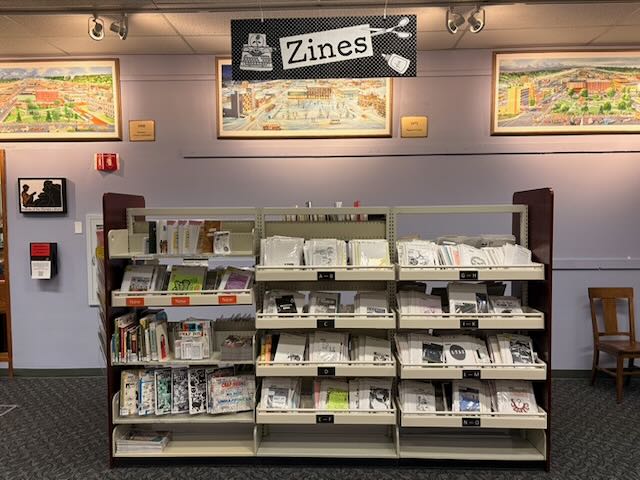
The zine library at the Timberland-Olympia Library. Photo by the author. Creative Commons License.

I am incredibly grateful for my time as a volunteer zine cataloger. If that taught me anything it’s that when the means of publication no longer work for you, it’s time to seize the means of publication for yourself!

Thankfully, while WordPress has spent the past few years ruining their product, an already existing open-source alternative has been growing in maturity: 11ty, an open source static-page generator framework that I think works beautifully for my intended use case and workflow. I have already used it to create a “pre-prod” instance that you can inspect for yourself. I’ve even successfully imported my previous blog content into it! I’m looking forward to migrating from pre-prod to prod shortly. 🙂

Aside from allowing me to write more easily I hope that self-hosting an 11ty instance will give me back control over my work and how I decide publish it – in accordance with my values of accessibility, sustainability, trustworthiness and open standards. I know this radio frequency has been silent, so I must ask yet again for you to stay tuned for the next update. 📡 It won’t be long this time – I swear! 😅

Emerging from Despair

By Edvard Munch – The Athenaeum: pic, Public Domain, https://commons.wikimedia.org/w/index.php?curid=38018045

I know have been radio silent online for much of the past few months. I have to be honest, I have been struggling with profound feelings of despair at watching the large scale attacks on civil society these past few months, with the knowledge that we have three-and-a-half years left of this. At least.

As a Librarian, watching the civic, institutional and diplomatic damage of the second Trump administration has been personally gutting. The breadth and deapth of the attacks on government institutions, knowledge, research and public service programs. It has been a non-stop shock-and-awe campaign against anyone and anything that benefits the public good.

The cascading chaos of DOGE, the Big Ugly Bill, and the United States reneging on its domestic and international commitments are the most visible actions that the public is seeing. All of that is outrageous enough. But that’s just the tip of the iceberg. What people are not seeing are the countless research projects that are silently being cut off. Some of these projects may find funding from other institutions, or other countries. Some, if not most, will probably just fade into obscurity. We are entering a research dark age.

I’m not speaking purely in hypotheticals, either. One of the most alarming examples are the defunding of incredibly valuable mRNA vaccine research grants. I could list countless others, across a myriad of scientific domains – all of them deserve more visibility advocacy on their own. However, as a Librarian with eye on Trustworthy AI policy, I have to limit my scope.

In particular, I want to highlight research projects that demonstrate tangible promise for implementing Trustworthy AI policies in the future. The bulk of these research project research projects were supported by the National Science Foundation (NSF) and the National Institute of Standards and Technology (NIST).

In 2023, the National Science Foundation was funding the National Artificial Intelligence Research Institutes. There were (are) seven research institutes decidated to various themes:

  • Trustworthy AI (TRAILS)
  • Intelligent Agents for Next-Generation Cybersecurity (ACTION)
  • Climate Smart Agriculture and Forestry (AI-CLIMATE)
  • Neural and Cognitive Foundations of Artificial Intelligence (ARNI)
  • AI for Societal Decision Making (AI-SDM)
  • AI-Augmented Learning to Expand Education Opportunities and Improve Outcomes (INVITE, AI4ExceptionalEd)

In 2024, NIST launched Trustworthy & Responsible Artificial Intelligence Resource Center (AIRC) and its NIST AI Risk Management Framework (AI RMF 1.0). As I learned about these technology and policy frameworks, I got really excited. I even had the pleasure to speak about it at IAC24 and DGIQW 2025.

But already, you can see erasure of of some of these research themes from reviewing changes to the NSF’s AI Research Institutes website. In listing its research themes you can see that Trustworthy AI and Climate Science have been de-emphasized. Most grant have been archived indefiniately.

Since then, the Trump Administration has released its AI Action Plan which I will maintain is intentionally vague. It also strategically de-emphasizes and omits the Trustworthy and Sustainability themes of AI research and policy.

From my prospective, this all looks bleak. After some grief, I have to remind myself that we’re not starting from zero:

  • Most of the research and publications have not been taken down (yet). Much of it is being mirrored elsewhere in case
  • Some of the research grants funding is still ongoing, others are finding other sources of funding
  • All of the peole behind these projects and papers are still around
  • While the US regresses in Trustworthy AI policy, the work of the European Commision, States and other regions moves foward
  • This administration is not forever

The feelings of despair are real. They are the product of an intentional campaign. I said Shock and Awe approach and I meant it. DOGE, and everything else along with it, is meant to despirit those who believe in the public good in any way whatsoever. If you feel despair, you are not alone and you are not overreacting. This feeling of isolation and helpeless is the point.

As time goes on, I find my despair shifting to anger. I return to the Internet after a Summer hiatus with a sense of intention. I want to find the people, organizations, and papers that are cointinuing to do good work out there. And by good work I mean work that is making search, AI or any information experience on the Internet more Trustworthy.

Voices like Gary Marcus and Ed Zitron have done great work drawing visibility on the larger problems with the current AI hype bubble. I would like to supplement their work by trying to draw more attention to specific technical mechanisms and legal definitions proposed for making generative AI more trustworthy, secure and reliable than it currently is.

Another person whose work I appreciate is Helen Toner, who brings a cybersecurity perspective to analyzing AI technologies. Work from Simon Willison, Kurt Cagle and Jorge Arango have helped me to get hands on experience with large language models that has provided understanding I would not have gathered otherwise. A lot of amazing people are still doing great work out there. I want to stand on the shoulders of giants to inspire mental models for Trustworthy AI as infrastructure, as policy goals, as a work intended for the public good.

By Badseed – Self-photographed, CC BY-SA 3.0, https://commons.wikimedia.org/w/index.php?curid=5997590

Don’t listen to the AI intimidation-mongers. You can understand how a Generative AI model works just as you can understand a crystal radio set. This technology is not “above our heads.” It’s weird, but it’s not magic. I’ve menioned how I feel that a lot of the public messaging about generative AI intentionally obfuscates how the technology works. My frustration (and anger) with this intentional obfuscation sparked a desire to write articles and give presentations as understandable as possible.

In the age of generative AI, I am of the mind that previously arcane issues of Information Science, Information Behavior Theory and Information Literacy have never ever been more culturally important or directly relatable. I aim to tie Trustworthy AI research and policy discussions to real-life, human examples with tangible benefits to the public and our daily lives.

Some topics I want to explore, for example:

  • Knowledge graphs, why they’re incredibly important (i.e. keeping generative AI models honest and up-to-date), and who is building knowledge graphs as infrastructure for information retrieval of the future.
  • The tactics and motivations behind the intentional obfuscation of generative AI technologies in the public discource
  • Exploring new technologies trees outside of traditional generative AI stacks, static and dynamic prompting, RAG and model routing (this is currently a gap in my understanding)
  • What a post-platform Internet looks like (Protocols Not Platforms!)
  • Those documenting the damage to insitutions and preparing for a post-MAGA rebuilding.

As I return from time offline, I look forward to connecting with others and taking part in the conversations to come.

As we fight these attacks on information access and the public good, I will leave off on two music-related notes. I will paraphrase Gord Downie, a personal hero of mine, when I say we should not tolerate these attacks on our institutions, collective knowledge and understanding with any patience, tolerance or restraint.

The destruction is overwhelming, but it is not forever. This song by Descartes a Kant, has been keeping me going. There will be creation after destruction. You’ll see.

Let’s find each other. Share solidarity. Let’s organize and pick up the pieces from these fucking vandals.

The State of Trustworthy AI Policy – Part 1 of 2

A photograph of the Seattle Central Library. The photo is distributed via Creative Commons License. More info: https://commons.wikimedia.org/wiki/File:Seattle_Library_01.jpg

With my colleague, Erik Lee, I had the great privilege to speak at the Information Architecture Conference in Seattle (at the beautiful Seattle Public Central Library) in April of last year. The topic of the presentation, titled “Beware of Glorbo: A Case Study and Survey of the Fight Against Misinformation” was about AI Data Poisoning (now also known as Prompt or Context Injection), but there was a section where I summarized the state of AI Data Policy, as I understood it then. People told me that the mental models I provided were helpful for getting bearings on the specific terms surrounding AI policy.

In light of this feedback, I thought it would be good to revisit this talk ahead of an update I’m giving later this year. But first, let’s view that state of AI policy terms in April of 2024:

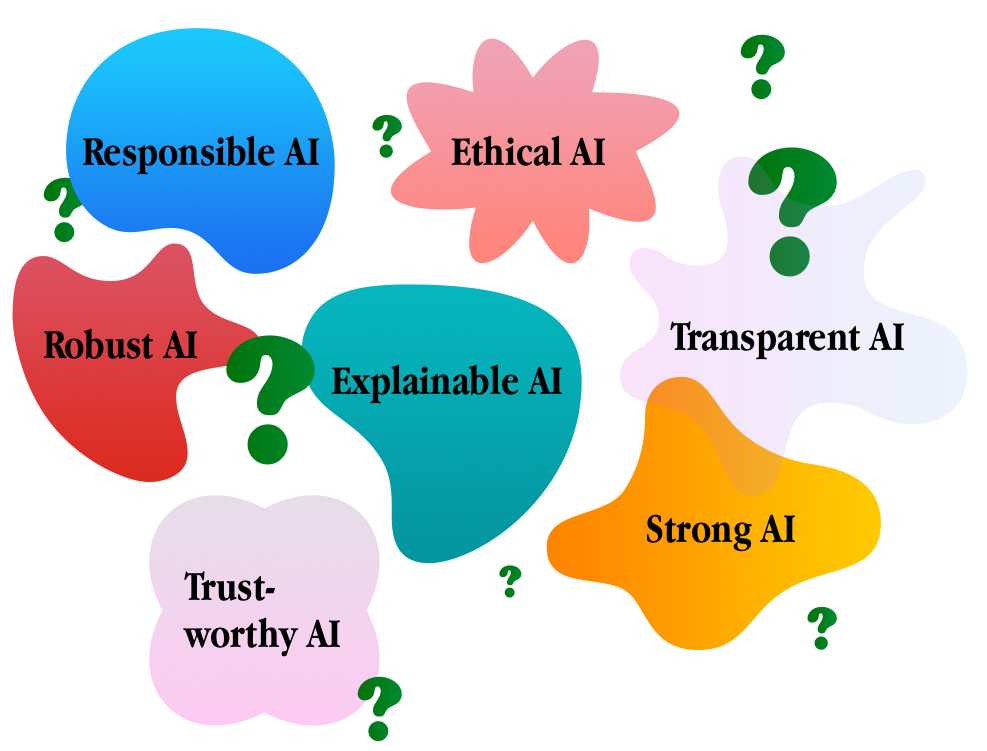
A diagram showing nebulous shapes haphazardly placed. Each of the shapes has terms such as "Robust AI," "Strong AI," "Trustworthy AI." The shapes are accompanied by question marks. This image is to convey the nebulous understanding of these terms in Spring of 2024.

My deck showed the nebulous state of popular AI policy terms that were being thrown around. The term names are not intuitively descriptive and the relationships between them is unclear, especially when sloppy marketing jargon would obscure their meanings as technical terms of art.

We start by setting definitions. Terms that were conceptually identical have been grouped.

  • Explainable/Transparent AI – AI that can explain the reasoning behind its output
  • Robust AI – AI that is technically robust: (consistent, accurate and secure)
  • Ethical/Responsible AI – AI that is inclusive, non-discriminatory, fair – may even have environmental considerations
  • Trustworthy AI AI that encompasses the above principles: safe, secure, consistent and accountable to enable trust in the AI output

Strong AI – AI that is aware of concepts, its own reasoning and itself as an independent agent

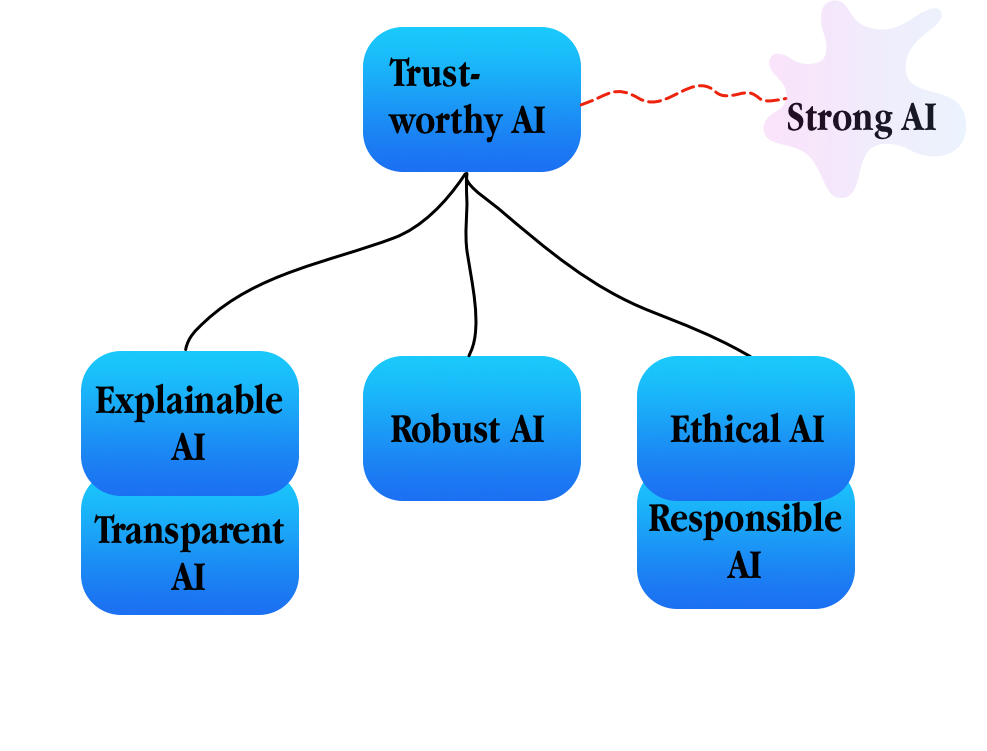
Using these definitions, I drew a diagram to help people visualize the state of these terms.

A structured diagram showing the reationship between terms. Trustworthy AI is at the top of the hierarchy. Three sub-groups are below it: Explainable/Transparent AI, Robust AI, and Ethical/Responsible AI. The term Strong AI is nebulous and disconnected.


In the diagram, I placed Trustworthy AI as a superset concept that includes each of the other AI policy concepts (explainable/transparent AI, robust AI, ethical/responsible AI) within it. Strong AI (now more commonly referred to as Advanced General Intelligence (or AGI) is disconnected since it is only theoretical.

This model is imperfect as these policies often overlap and share goals, definitions and desired outcomes. I found, however, thinking of each of these policies as contributing to the larger goal of Trustworthy AI to be a helpful way of understanding each of these policies and how the relate to each other.

In addition to defining and contextualizing these AI policies to one another, I also profiled the organizations making the most waves in these spaces and what had been published and legislated up to that point.

The heavy hitters that I had found were:

Additionally, I noted some movement in the Executive and Legislative branches of the United States government at that time.

Now, nearly a year later what has changed? A lot, as you can all imagine.

I will speak about this at DGIQ West 2025 in a talk titled “Catching Up with Glorbo: Combatting AI Data Poisoning with RAG Frameworks“. You won’t have to wait until May, as I plan to write about this in Part 2 ahead of the conference. In the meantime, here are some highlights include:

Thank you to everyone who has encouraged me to continue write and speak about this subject. Stay tuned for part two. Please don’t hesitate to reach out to me with helpful feedback (that includes corrections). 🙂 See you soon in Part 2.

On Launching a Blog in 2024

Like a lot of people in tech in the years leading up to, during, and after COVID, my relationship to the Internet and technology changed on a profound level.

Photograph of the author circa 1998. An "awkward" teenager in front of a computer desk stacked with books.
The author at the start of his information science journey, ca. 1998

I spent the greater part of my youth devouring and regurgitating tech and internet hype. I sincerely believed that information technology was the solution to most, if not all, of society’s ills. I was too caught up in the novelty of this new technology to consider the serious downsides. It wasn’t all bad, however. This enthusiasm led me to get my Library and Information Sciences degree.

Ironically, it was the insight gained from my MLIS degree that contributed to my declining enthusiasm for technology. As the implications of disinformation and information illiteracy played out in recent years, I watched my relationship with technology swing from a source of inspiration to a fount of existential dread. In time, outside of what I needed to do for daily work, I withdrew from social media and the Internet almost entirely.

Photograph of the author in his 30's in front of a working Xerox Alto computer from 1973 at the Living Computer Museum in Seattle
The author at the peak of my tech exuberance. Rest in Peace, Living Computer Museum

Others have written with similar experiences. We’ve all heard the reasons: the enshittification of the Web, misinformation, cyberbullying, how generative AI is making the Dead Internet theory more of a reality, Zoom Fatigue. At this rate, why bother with the web anymore? Anything you post is going to be used to train generative AI models, further continuing to crowd out signal with noise.

A garish image of a computer-generated skeleton holding a machine gun in each hand. In clashing fonts and colors text reads "BRING BACK RSS READER'S [sic] AND BLOG'S"
The amazing work of “Admin” from da share z0ne. Replace your entire wardrobe and buy all of their merch

And yet, I’ve been inspired watching some colleagues in my professional network, such as Tracy Forzaglia and Stuart Maxwell, restart websites and blogs. Additionally, I love the work of Molly White (Web 3 is Going Just Great, Follow the Crypto) and her work reminds me the value of having a platform that you control. The old Internet is still there, dammit.

I also had a great conversation with Jorge Arango at IAC 2024. This conversation was partially responsible for Jorge writing an article about why the IA field needs to get out of the AI doldrums. The conversation also helped rekindle my curiosity towards these new technologies.

Yes, the harms are real and they will continue to grow, horrifyingly, in scale. As Jorge reminded me, nay, challenged me, that doesn’t preclude us from getting nerdy with the tools to find out what good they can do. Challenge accepted.

In addition to writing about “AI” technology itself, I plan to discuss developments in policy such as:

  • Transparent or Understandable AI
  • Ethical or Responsible AI
  • Trustworthy AI
  • Robust AI
  • Sustainable AI

I also want to write about topics relating to:

  • Linked Open Data “infrastructure”
  • Information Theory in everyday life
  • Humane design and the ethics of information environments
  • Stuff I just think is neat
An image of Marge Simpson holding a potato saying "I just think they're neat."
Marge Simpson holding a potato and saying “I just think they’re neat.” Be like Marge

I am not a Machine Learning or Generative AI expert. I don’t have a software engineering degree. But I hold a Masters in Library and Information Science from the University of Washington Information School. I am an experienced Taxonomist, Ontologist, and Information Architect, who has had the pleasure to work with semantic technologies in enterprise environments. I hope to use this platform to have professional conversations, learn in public, and also to help other learn in the process.

I’m excited to explore what we can do when we take the means of communications back from centralized platforms. I think the Internet can be “fun” again.

Protocols Not Platforms!
Pods Not Profiles!

Disaffected info nerds of the word, unite! ✊- Sherrard

A recent photograph of the author, standing in a field with a beard, wearing sunglasses, a cap, large headphones and a shirt by dashare.zone reading "IT IS NO LONGER POSSIBLE TO 'LOG OFF'"
The author further on in years. A little more jaded, but still an information nerd