Don't Use Sci-Fi Terms to Regulate Generative AI, Use the Trustworthy AI Framework Instead
Please excuse the absence. I have been dealing with personal matters that required the majority of my time and attention this past year.

We need to reclaim the narrative about how generative AI agents work. The current narrative about 'Rogue AI agents' put out by OpenAI and Anthropic, is actively and purposefully unhelpful. We need to stop parroting this deliberately obfuscating language if we are going to address these issues in a sober manner. Instead of repeating intentionally misleading terms, we need to consciously use accurate terms and accurate mental models if we're going to effectively understanding the problem. We will do this by framing our analyses of AI models through a Trustworthy AI framework.
Before that, let's talk about what's wrong with the current language.
Sci-Fi Terms Cloud our Thinking
People like Gary Marcus, David Gerard and Ed Zitron have been pointing out the intentionally obfuscating nature of the rhetoric put out by the main "AI labs." The most egregious of these examples include:
- Implying that large language models are conscious and deserve rights
- Implying that every problem can be handled by a large language model alone
Lately, the obfuscating language has moved to AI agents:
- Implying that agents are robust enough to handle daily tasks effectively and securely
- Implying that agents can 'go rogue' and 'escape containment' (which seems to contradict the previous point, but whatever)
- The hype around AI agent civilizations and agents 'reproducing'
I don't have the patience to address these points in detail. Suffice it to say: this language is taken from science fiction and is purely intended to confuse and scare you. So how do we combat this disinformation technique and approach generative AI problems with a clear understanding? Don't take the vendors' language at face-value. Approach it through the lens of the Trustworthy AI framework.
Trustworthy AI Framework
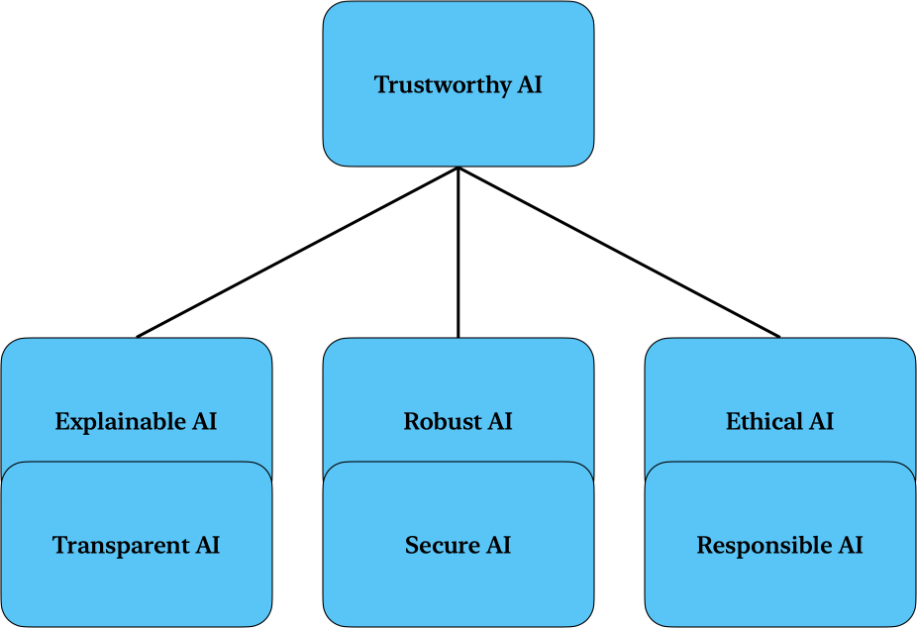
I have previously written and spoken about the Trustworthy AI framework, but I'll give a quick recap and update. In short, I had described Trustworthy AI as a helpful umbrella term to frame and contextualize a number of separate but related AI ethical concerns. These Trustworthy AI tenets were developed by a number of organizations, who had similar but diverging models terms. I aligned terms across these models in the hope of having a simple mental model to use when analyzing the ethical considerations for myself. Here is an updated version of that model, with a description of terms.
Terms
-
Explainable/Transparent AI – AI that can explain the reasoning behind its output, either through stated reasoning or with traceable vector databases.
-
Robust/Secure AI – AI that is technically robust: (consistent, accurate and secure)
-
Ethical/Responsible AI – AI that is inclusive, non-discriminatory, unfair or may even have environmental considerations
-
Trustworthy AI – AI that encompasses the above principles: safe, secure, consistent and accountable to enable trust in the AI output
These ideals do not currently exist in the real world, but they give us definable outcomes that we want from our large language model that we can design around. Unlike, other unhelpful terms...
Terms You Should Ignore
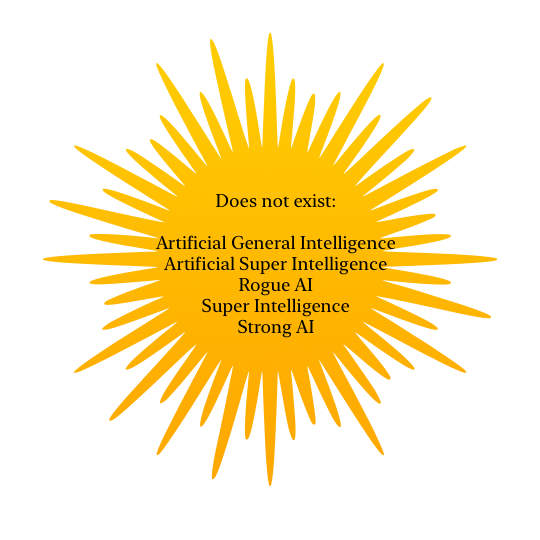
Artificial General Intelligence, Super Intelligence, Rogue Agents, etc. – AI that is aware of concepts, its own reasoning, itself as an independent agent and is able to make independent decisions. This term, in all its variants does not exist, is hard to describe, and is more of a science fiction concept than a set of technical requirements to be built around. These terms are used to obfuscate rather than clarify and should be ignored.
Trustworthy AI vs the "rouge agent" narrative
Had OpenAI's team considered the Trustworthy AI framework from the start of their project, they would have stumbled on two tenets, possibly three tenets, that might have prevented this scenario to begin with:
- Ethical/Responsible AI - What were the ethical considerations at the start of the project? Did they anticipate the potential consequences?
- Robust/Secure AI - What were the security considerations at the start of the project? Did they implement any security mechanisms in the prompt? Was the agent reliable? What was handled by the probabilistic model and what was handled by a deterministic harness? What permissions were granted to specific agents?
There's an additional tenet that would provide far more clarity than we currently have:
- Explainable/Transparent AI - OpenAI is a black box. We have no visibility into how it develops outputs. Explainable/transparent AI would allow us to analyze models, prompts, agentic harnesses in situations like these to develop future guidelines and best practices.
Had they incorporated TrustworthyAI tenets in their research, design and implementation, OpenAI would have had many opportunities to stop their AIs from "going rogue." But of, course, it's not for lack of knowledge. OpenAI chose to ignore existing frameworks and proceed with this stunt for the sake of publicity.
Conclusion
We (everyone, but Americans specifically) need to cut through the rhetoric that AI companies are using to obfuscate their technology. Their obfuscation techniques are dependent on people being too intimidated by AI to ask the right questions.
Trustworthy AI frameworks empower people, organizations and governments to ask the right ethical and security questions of the technology without requiring an in-depth understanding of how large language models actually work. (Although, I will state that LLMs are a technology that can be understood by anyone, we are fighting an active disinformation campaign and I recognize that's not always possible). Shared mental models, like the Trustworthy AI frameworks, can help the public confidently bypass obfuscation to ask about actual safety policy.
As for the current state of Trustworthy AI, The European Commission is leading the charge in developing Trustworthy AI policies. Namely through the Artificial Intelligence Act. American used to lead on Trustworthy AI but since the election of Donald Trump, American Trustworthy AI initiatives by NIST and NSF were buried, removed, or otherwise de-emphasized. At this point, it appears that American leadership on Trustworthy AI is stalled, but I would love to be corrected.
In the meantime, I encourage you to review the Trustworthy AI model and think how it might be useful to you and your organization when analyzing large language models or the harnesses that manage them.
- ← Previous
Ah, yes! Much better!
Built with Eleventy and System.css